Material collection — book project out of “At the Edge of the Known”
Work in progress. Nothing is finished. Only ordered.
The title and what it carries
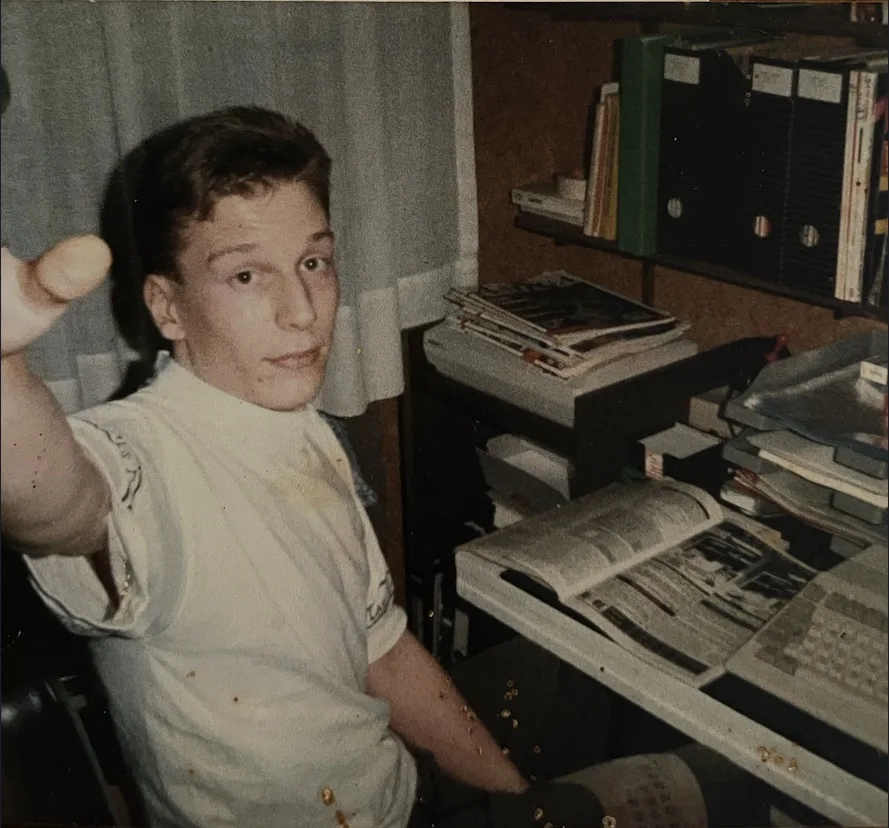
“Dilles, an F, sit down!” — the teacher’s sentence. Public punishment. The stamp: failed.
The tension underneath, the one that carries the whole book:
- An F in dictation — following the rules, copying correctly, fitting in, flawless reproduction of what was handed down.
- An A in the essay — your own thought, your own observation, your own voice. With edges.
The system measures dictation. It measured the wrong thing.
A childhood without a net. No internet to look things up, no spellcheck, no AI. Dictation was the pure test of conformity — and that is exactly where Dilles failed. In the essay, where thinking was the point, he was out front.
Through line of the book: Whoever fails at dictation and shines in the essay has no deficit. He deserves a different measurement. School measures dictation. LinkedIn measures dictation. The AI debate measures dictation.
The core figures (movements of thought that recur)
These are not chapters but movements that surface across several texts:
- The problem lies BEFORE the technology, not in it.
- “Before AI, you first have to save on AI.”
- “We outsourced thinking — long before we wrote the first prompts.”
- AI only makes visible / measurable what had been there all along.
- The skipped moment.
- The wrestling with your own thought. The discomfort when you don’t yet know what you think. The pause between experiencing and putting into words.
- Most people skip it and go straight to writing. LinkedIn-compatible. Done.
- Whoever speaks truth, loses.
- Calibrated physics intuition since 9/11 (WTC 7, free fall).
- The pattern: telling the truth costs — at school, at work, online.
- Conformity as a trap, difference as a source.
- Whoever never learned to fit in frictionlessly has more of their own voice left. Not despite the difference — because of it.
- (Neurodivergence connection, surfaced in the LinkedIn thread.)
- Maker -> observer/documentarian.
- From building to observing and recording.
- Build the technology of 2030, not today’s.
- Core thesis, May 2026. A success factor for startups, impossible for corporations (legacy, inertia).
Material from “At the Edge of the Known” (newsletter substance)
- Issue 02: “Is AI a new form of life?” — still unpublished.
- Issue 04: “What AI does to the human being.” — conceived as the opening of a book that unfolds across issues. Contains the 9/11 physics-intuition layer and the pattern “whoever speaks truth, loses.”
Observation: the newsletter was meant as a book-in-issues from the start. “Dilles, an F, sit down!” is the form that makes good on that.
Life stations as possible material (inventory only, not sorted)
- Childhood without a net. F in dictation, A in the essay.
- TV repairs — the first reward through understanding systems, not through social approval.
- IT since 1998.
- TIMOCOM, employee #4, 11 years (development, then marketing).
- farmeramania.de — 1 million+ users/month at its peak. Community resonance.
- Webbinder, 16 years, closed 31 December 2025.
- First PyTorch LLM in 2019.
- Ellen at Coyote/RXO — one of the first ChatGPT-based chatbots in Germany, built without an off-the-shelf kit.
- 2025: 12 months of intensive AI research, 12-20 h/day.
- 2026: sovereign-continuity architecture. MARTIN, LogpyClaw, OpenNet, ALICE, logpy.
Tone samples (the voice that has to carry)
Dry, laconic, short cuts. Evidence from my own texts:
It’s not about conformity. Conformity happens. Always has. It’s human. What got lost: the moment before it.
Most people skip exactly that moment — and go straight to writing. LinkedIn-compatible. Done.
A local AI model is enough for simple testing. Not for more.
Features of the voice:
- Short sentences. Paragraphs as places to breathe.
- Assertion instead of explanation. First the claim, then (maybe) the evidence.
- The double dash as a deliberate break.
- A dry cut at the end of the sentence (“Done.”, “Not for more.”).
- First the obvious answer, then the twist beneath it.
Recurring method (could be a motif of its own in the book)
The conceptual trap / the litmus test:
- “seducible” instead of “available” — double meaning as a test of who’s reading closely.
- Place two contradictory statements side by side and watch who feels the friction and who slides right over it.
- The like pattern as analysis: many like the first one, then they don’t care. The contradiction in the second is the sieve.
The book itself could be built this way: it tests its reader instead of serving him.
Open questions (for later, not now)
- Order: chronology of childhood, or movements by theme, or the logic of the issues?
- How much childhood / how much AI? The dictation image as a frame or as a thread running all the way through?
- Which newsletter issues become chapters, which stay newsletters?
- Should the “method” (testing the reader) be spoken openly or only practiced?
Leave a Reply