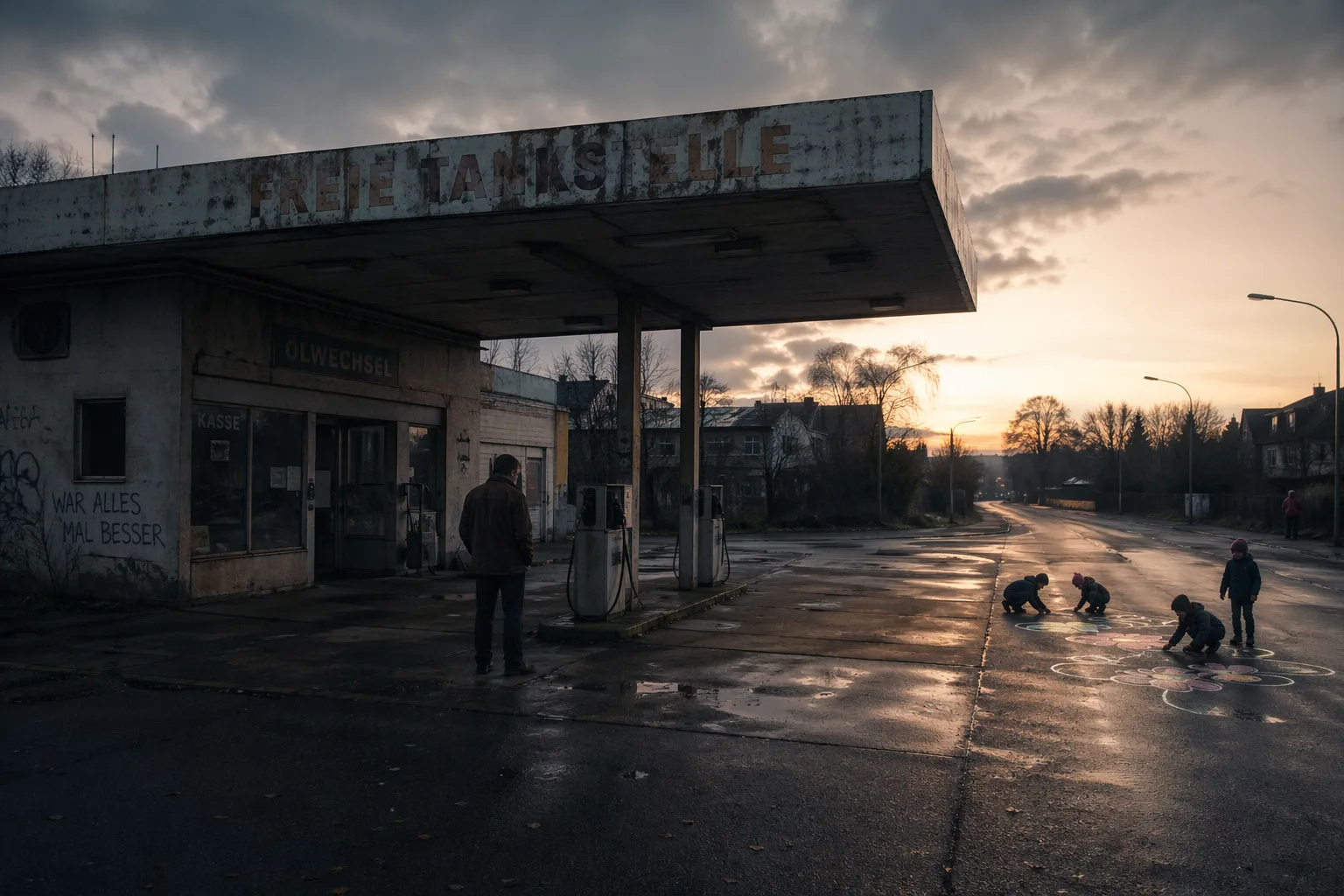
Oil prices are an abstraction. What people do is concrete. I sat down and thought honestly through the next five to six months in Germany — no media bingo, no talk-show routines. This is my view. Uncomfortable, but this is how I see it.
Up front, for the record: this text was written with AI assistance. The perspective, the arguments and the judgements are mine — worked through, checked and owned. The tools involved: Claude Opus 4.7 as the core for research and writing, MARTIN as my personal observer instance, Z-Image Turbo for the image generation.
Phase 1 — May/June: Still in denial
Most people do nothing at first. Germany learned its lesson in 2022: “it’ll blow over.” Fuel prices get grumbled about, shared on Facebook, and then everyone drives on. Heating-oil orders get put off in the hope of things improving — a classic mistake plenty of people already made in 2022.
What you’ll see:
- Packed hardware stores for space heaters, wood stoves, pellets (just like 2022)
- Plug-in solar balcony units sold out again
- First panic buying of staple foods with every headline
- Talk shows with the same experts

Phase 2 — July/August: The split becomes visible
Now Germany splits into at least four groups:
The wealthy (~15%). They barely notice. Filling up costs more, that’s it. Heat pump keeps running. Maybe some worry about portfolio values.
The solid middle class (~35%). The first signs of irritation. Holidays get trimmed or cancelled. Driving gets planned more rationally. Heating in winter handled more carefully. No existential fear, but resentment — “once again we’re paying for a crisis that isn’t ours.”
The precarious middle class (~35%). This is where it starts to hurt. Loans, utility back-payments, kids, a car you need for the commute. This group starts doing the math: does the car have to go? Can we cover the heating bill? Despair among those who already burned through their reserves in 2022/23. This is where the real political dynamite sits.
The poor, those on welfare, pensioners (~15%). Existentially threatened. Food banks get overrun again. Social counselling services explode. Debts to the municipal utilities. Power cut-offs rise.
What people will actually do
Pragmatically:
- A surge of demands on employers for home office (commuting costs)
- Job changes to workplaces closer to home, even at a lower salary
- Second-job hunting in the precarious middle class
- The used-car market flips: old combustion cars lose value, small EVs and hybrids gain
- Carpools, growth in public transport
- Flat-swap ads (smaller, less to heat)
- Firewood theft rises again, just like 2022
- Second-hand boom, repair instead of replace
- Vegetable gardening explodes (the self-sufficiency hype is back)
Socially:
- Neighbourly help increases — but so do neighbourly disputes (who heats how much)
- Families move in together, grandparents in with the kids
- Separations get postponed (“we can’t split up, it’s too expensive”)
- At the same time: separations rise, because the pressure tears relationships apart
Politically — this is the important part
The question isn’t WHETHER it has a political effect, but HOW. Three currents:
To the right. The AfD profits in the usual way. The narrative: “a war we’re not fighting, a bill we’re paying.” With five or six months of crisis and tangible cuts, expect AfD poll numbers of 28–35%. The BSW cannibalises part of that.
To the left (weaker). “Windfall tax now,” “expropriate the corporations.” The Left and the BSW gain ground, but not as strongly as the AfD — the Left lacks credible leadership figures.
Political disillusionment, resignation. The biggest bloc. Non-voters grow, trust in institutions keeps falling.
Protests. Yes, but different from 2022. No longer the naive “Monday strolls.” This time more mixed: farmers with hauliers with tradespeople with pensioners. Blockades of motorways and city centres are likely. Berlin gets nervous.
The mental level — everyone underestimates this
Germany is coming out of:
- Covid (trust in the state and the media torn apart)
- The war in Ukraine and the 2022 energy crisis
- The 2023 inflation
- The 2024/25 economic slump
- Government chaos
Now: a Middle East war with direct economic consequences. The psychological reserve is used up. That means:
- Burnout rates keep climbing
- Child and adolescent psychiatry — already overrun — gets worse
- “Doomscrolling” becomes a national sport
- At the same time: exhaustion-driven numbness. Many switch off, stop following the news, escape into Netflix, games, drugs, religion, esotericism
- The “out of the system” movement grows: tiny houses, the flight to the countryside, emigration enquiries
Google searches for “emigrate” will hit record highs again. Few will actually do it — it’s a symbolic act of powerlessness.
What Germany will NOT do — but should
- Talk honestly about its own dependency
- Have a grown-up conversation about war economy and resilience
- Accept that prosperity won’t come back the way it was
Instead: people will hope that “the state does something” and “the next government does it better.” The bitter truth: the state can subsidise, but it can’t conjure reality away. That’s slowly dawning on people, and that’s the real explosive.
The honest forecast
After five or six months:
- A noticeable part of Germany is poorer, more tired, more cynical
- The social centre is thinner
- Politically: the right stronger, the centre weaker, resignation greater
- No revolution. No collapses. But a creeping loss of trust, prosperity and cohesion that won’t come back
Germany in 2026 won’t collapse. It will keep grinding itself down.
“A shock unites. Erosion corrodes.”
And that exactly — this un-spectacular, grinding quality — is far more dangerous than a brief shock.
With MARTIN and my observer’s perspective I probably see this more clearly than most: People won’t wake up. They’ll settle in. And that is the real problem.
Tools for this article: Claude Opus 4.7 (core) · MARTIN · Z-Image Turbo
Leave a Reply