
WP 7 “Armstrong” is out — and I’ve been here since day one.
WordPress 7.0 “Armstrong” shipped today.
I was still running WordPress 1.0 “Miles”. That was January 2004. No block editor, no REST API, no full-site editing — just a text field, a Publish button, and the idea that everyone should be able to publish for themselves. That was radical enough.
Since then I’ve left WordPress, come back, left, come back again. Ghost, Hugo, Kirby, Eleventy, plain HTML. I know the alternatives. I’ve built them and run them.
And I’m back on WordPress. This time for a different reason.
What changed: AI needs a house
Most people talk about AI features in WordPress. I mean the opposite: WordPress as the right housing for AI.
When I build AI into a website — and I do that every day on www.www.dillenberg.net — I need:
- Structured content. Not a heap of Markdown files in a Git repo, but taxonomies, meta fields, relationships between posts. Things an AI can query and understand.
- A permissions system. Who’s allowed to see what, who’s allowed to write what, what’s public, what’s behind a login. WP has had this solved for 20 years.
- An API. The WordPress REST API gives me everything — content, users, comments, custom post types — in a clean JSON format that any AI can consume directly.
- A plugin system. When I build a new AI feature, I build an mu-plugin. Lean, versioned, deployed with a single command. No homegrown framework required.
Ghost can’t do this. Eleventy can’t do this. A custom Node stack can do it in theory — but then I’m building it myself, and that’s three months of work WordPress already finished in 2008.
WP 7 makes it official
WordPress 7.0 brings a native AI Client Layer straight into core:
- Web Client AI API — a standardized interface plugins and themes can use to talk to external AI providers. Provider-agnostic. If you use OpenRouter, you swap out one argument.
- Connectors API — manages credentials and provider selection at the platform level. No plugin has to build its own key logic anymore.
- WP AI Client SDK — a unified JavaScript interface for all AI communication on the frontend.
This is the language I’ve been hand-building for the last year and a half. Now it’s in core.
What that means: a growing ecosystem of plugins that share the same AI connection layer. Plugins that complement each other instead of getting in each other’s way. A shared infrastructure everyone benefits from.
What I’d already built — before it was in core
For months, www.www.dillenberg.net has been running exactly what WP 7 is now standardizing:
ALICE at /alice/ — a custom chat with TTS (Mistral Voxtral, 7 voices), provider-swappable, running over OpenRouter.
Article Agent beneath every blog post — highlight text, ask a question, get an answer that clearly separates from the article and my conclusion.
UFO Companion — context notes via laser scan, persistent per browser, per page. Three answers for guests, unlimited for logged-in users.
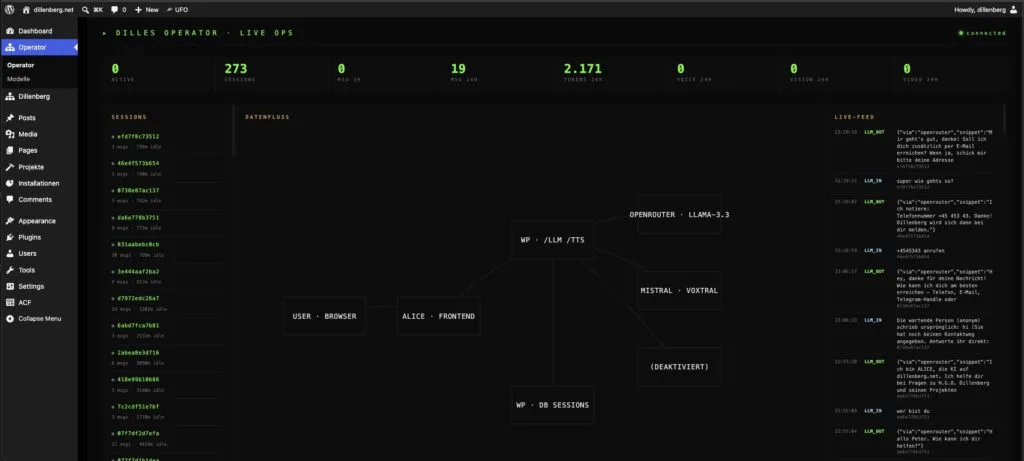
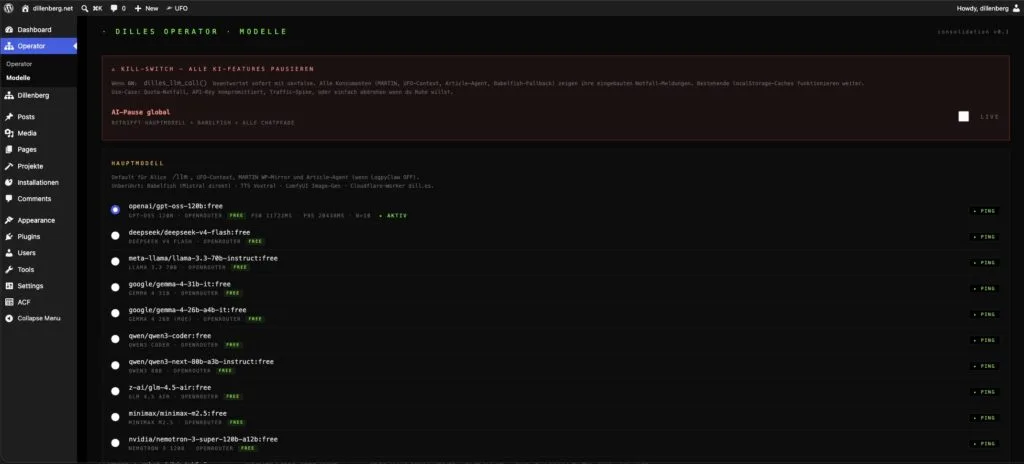
Operator Dashboard in the WP admin — live sessions, message flow, token counter, all built straight into the backend over SSE. The screenshot above shows the model selector live: which free LLM is currently active, latency, ping status.
rent-a-human A2A endpoint — a spec-compliant A2A v1.0 agent at rent-a-human.www.www.dillenberg.net, so other AI agents can talk to the system directly.
None of these features needed a plugin from the marketplace. They all run inside the WordPress frame. The frame was the right call.
WordPress 2030
The roadmap image makes it plain: WP is moving toward a platform that unites content, collaboration, and AI in one system. Not as a feature parade, but as infrastructure.
I’ve had that roadmap image on my radar for months. It explains why, after a lot of detours, I’m back here.
WP 1.0 democratized the web. WP 7 is starting to democratize AI — not as a toy, but as a tool anyone can run. On your own server, with your own rules, no API lockout.
The short verdict
If you’re weighing what to frame your next AI project with:
WordPress isn’t the hip choice. It’s the durable one. It took 22 years to get here. But it arrived.
My system is live. You can take a look: www.www.dillenberg.net
If you want to know how it’s wired up technically — from server to nginx, mu-plugins, all the way to the deploy workflow with Claude Code — say so in the comments. I’ll write it up.
Related article: WordPress and AI are a dream team — the full technical overview of the system behind this site.
Leave a Reply