Most people don’t see how fast this is moving. They think of AI as something for the future — something that’s coming. It’s already here, it’s running, and it’s reshaping IT at a pace public perception doesn’t capture. At the same time, what’s actually happening keeps getting systematically misrepresented.
This piece pulls apart three things that constantly get conflated: the real rebuild, the staged narrative — and the question of what to actually do about it.
I · What’s already happening
The silent dismantling
There’s no loud bang. That’s exactly what makes it dangerous. Employment of software developers aged 22 to 25 is now roughly 20% below its late-2022 peak — measured by the Stanford Digital Economy Lab across millions of actual payroll records. This isn’t a projection. It’s the past, already done.
- −49% — software-engineer postings vs. early 2020 (Indeed Hiring Lab · July 2025)
- −73% — junior hiring in European tech firms YoY (Ravio · EU analysis 2025)
- +59% — ML-engineer postings vs. pre-pandemic (Indeed Hiring Lab · 2025)
- 84% — developers actively using AI tools (Stack Overflow Survey 2025)
The pattern is clear: standard roles are collapsing, specialized roles are exploding. But the remarkable part isn’t the layoffs — it’s the non-hiring. Companies aren’t firing anyone. They simply stop backfilling. Klarna shrank its workforce from 5,000 to 3,500 through natural attrition without a single public layoff. That doesn’t make headlines. It doesn’t trigger resistance. And that’s exactly why it looks calm from outside while the talent pipeline gets quietly hollowed out.
⚠ The delayed damage
Skip hiring juniors today and you have no mid-level engineers in 2031. Skip building mid-levels and you have no seniors in 2035. The industry is eating its seed corn — and won’t notice until the harvest fails.
II · What’s being told wrong
AI-washing: layoffs dressed as progress
This is where it gets uncomfortable. Because alongside the real shift, something else is running — strategic, systematic, and largely unchallenged.
AI was cited as the reason for roughly 55,000 US job losses in the first eleven months of 2025. Sounds like a lot. Losses attributed to “market and economic conditions” in the same period: 245,000 — four times as many. AI-related losses made up just 4.5% of the total.
A Harvard Business Review survey of more than 1,000 executives in December 2025 surfaced the core of it: over 600 admitted they’d executed layoffs in anticipation of what AI might do — not because of actual efficiency gains. Meanwhile, more than 80% of companies report no measurable productivity jumps from AI despite billions in investment.
“Companies want to get rid of departments that aren’t pulling their weight anymore. And AI right now is partly façade, partly excuse.”
— Lisa Simon, Chief Economist, Revelio Labs
The reason is mundane. “AI transformation” sounds like competence and future. “We over-hired in 2021 and high interest rates are crushing us” sounds like failure. Executives have learned which one produces less public pushback. The layoff is the same — only the packaging becomes a success story.
III · Why the lie is dangerous
The narrative outpaces reality
You could find this reassuring: if most “AI layoffs” aren’t really that, the situation must be better than feared. That would be a mistake.
AI-washing has a collateral damage that outweighs the short-term deception: it normalizes the story. Whoever says “AI made us more efficient” today and lies about it will say the same sentence in three years — and then it’ll be true. The ground for the real displacement is being prepared with untruths. By the time it arrives, the language is already worn down, and no one can tell the difference anymore.
| Layer | What’s said | What actually applies |
|---|---|---|
| Official | “AI drives the transformation” | Investor Relations gets an innovation narrative |
| Actual | — | Interest rates, correction of post-pandemic over-hiring, weak demand |
| Long-term | — | The real displacement is coming — slower, more uneven, without warning |
Education systems, job seekers, and policymakers react to the narrative, not to the data. CS enrollment is already falling. Funding programs are being restructured. Entire career biographies are being decided on the basis of a story that’s half investor-PR.
IV · The honest forecast
What’s coming — and when
- 2026 – 2027 · Now — The silent erosion. No tsunami. Companies don’t backfill, rates stay high, hiring stays frozen. AI-washing as dominant communication mode. From the outside it looks calm — in reality the pipeline gets hollowed out.
- 2028 – 2030 · Visible — The pipeline collapse becomes tangible. The companies that aren’t building juniors now will look for mid-level engineers and find none. At the same time, AI agents actually take over parts of development work. Real change and self-inflicted scarcity collide.
- 2029 – 2035 · New equilibrium — Fewer roles, different roles, higher concentration. Not “AI replaces everyone” — but: those who understand orchestration work on a layer that’s hard to copy. Those who only knew syntax have no function anymore.
The chaos of the coming years won’t be the dramatic wave many expect. It’ll be quiet, distributed, and visible too late — until the systems that AI-generated code has been building up for years start breaking, and nobody understands why anymore. Because the people who would have understood never got the chance to learn it.
V · The lever
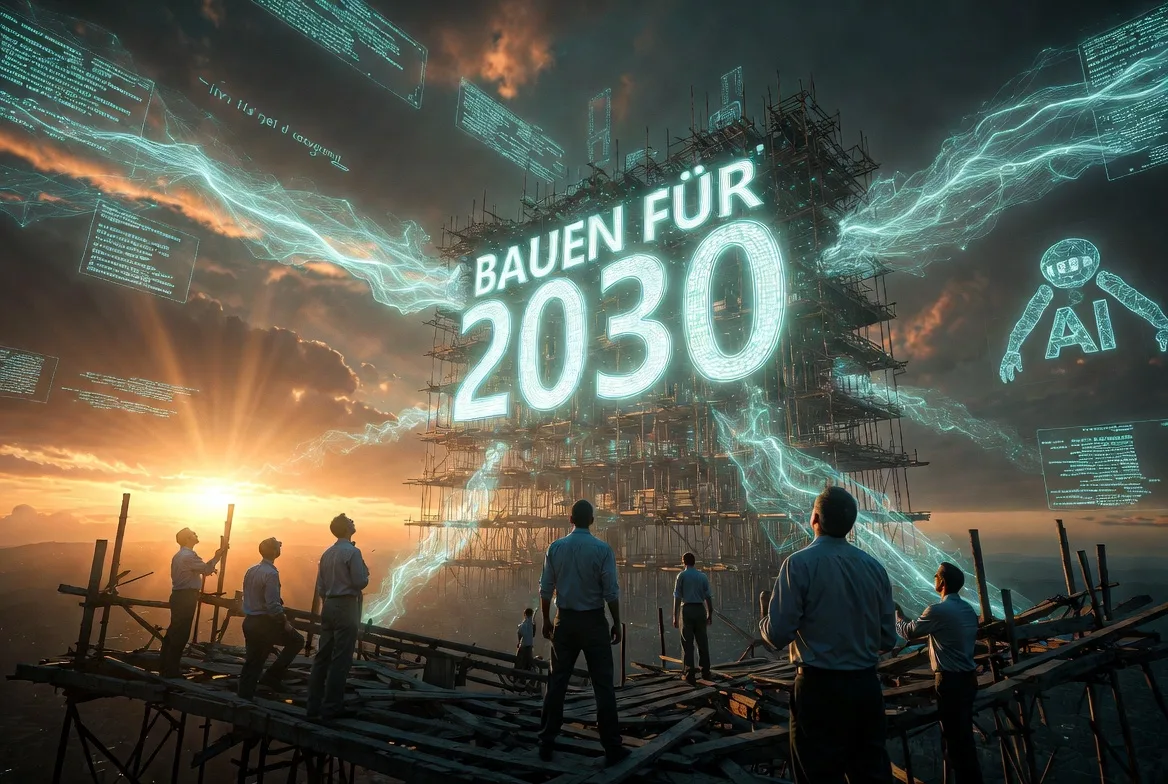
Build for 2030
Up to here, this piece has been diagnosis. But I’m not the kind of person who announces chaos and walks away. I build. So the ending isn’t a warning — it’s a lever.
You have to build and use the tech today the way it’ll be in 2030 — not the way it is in 2026.
Sounds simple. It’s the exact opposite of what most people are doing. The reflex is to optimize the current state: make the existing system faster, cheaper, slightly more AI-assisted. That’s understandable — and it’s the trap. Build 2026 for 2026 and you have a product that’s outdated the moment it ships. The half-life of architecture decisions has shrunk to months.
Why the big players can’t pull this off
This lever is the actual success factor for startups — precisely because established corporations structurally can’t pull it. Not out of stupidity. Out of physics.
A large company is a system with enormous inertia. It has legacy code that mustn’t be touched. It has stakeholders whose job is to defend the status quo. It has quarterly targets that punish any bet on a state that doesn’t yet exist. A corporation can’t build for 2030 because its entire structure is designed to manage 2026. That’s exactly the gap.
A startup has none of these chains. No legacy ballast, no internal status-quo interest, no twelve approval gates. It can build from a blank page for the state that’s coming: local, decentralized, sovereign systems instead of cloud-centric dependency. Agent architectures instead of monolithic applications. Post-quantum security from day one, not as a later patch. This isn’t a race for speed. It’s a race for the right target.
The advantage isn’t running faster. It’s running toward the right target.
— Core thesis
This is also the answer to the broken ladder from part one. Value shifts from execution to judgment — from fast coding to understanding systems, designing target states, orchestrating. This is exactly the layer the AI wave doesn’t wash away — it makes it scarcer and more valuable. Build it now and you don’t position yourself for the current market. You position yourself for the one that’s coming.
Conclusion
What remains
Two things are simultaneously true: the AI-driven rebuild of IT is real, measurable, and in full motion. And: much of what runs under the “AI” label today has other causes and is deliberately mis-framed. Hold both apart and you see clearly. Follow the narrative and you decide based on a half-staged reality.
The actual upheaval isn’t here yet. It’s coming — quietly, without announcement, at the worst possible moment for everyone who bet on the current state. But it’s also coming as opportunity: for anyone willing to build today for the day after tomorrow.
The question isn’t whether the world is turning. It is. The question is whether you build where it stands today — or where it’s heading.
Leave a Reply