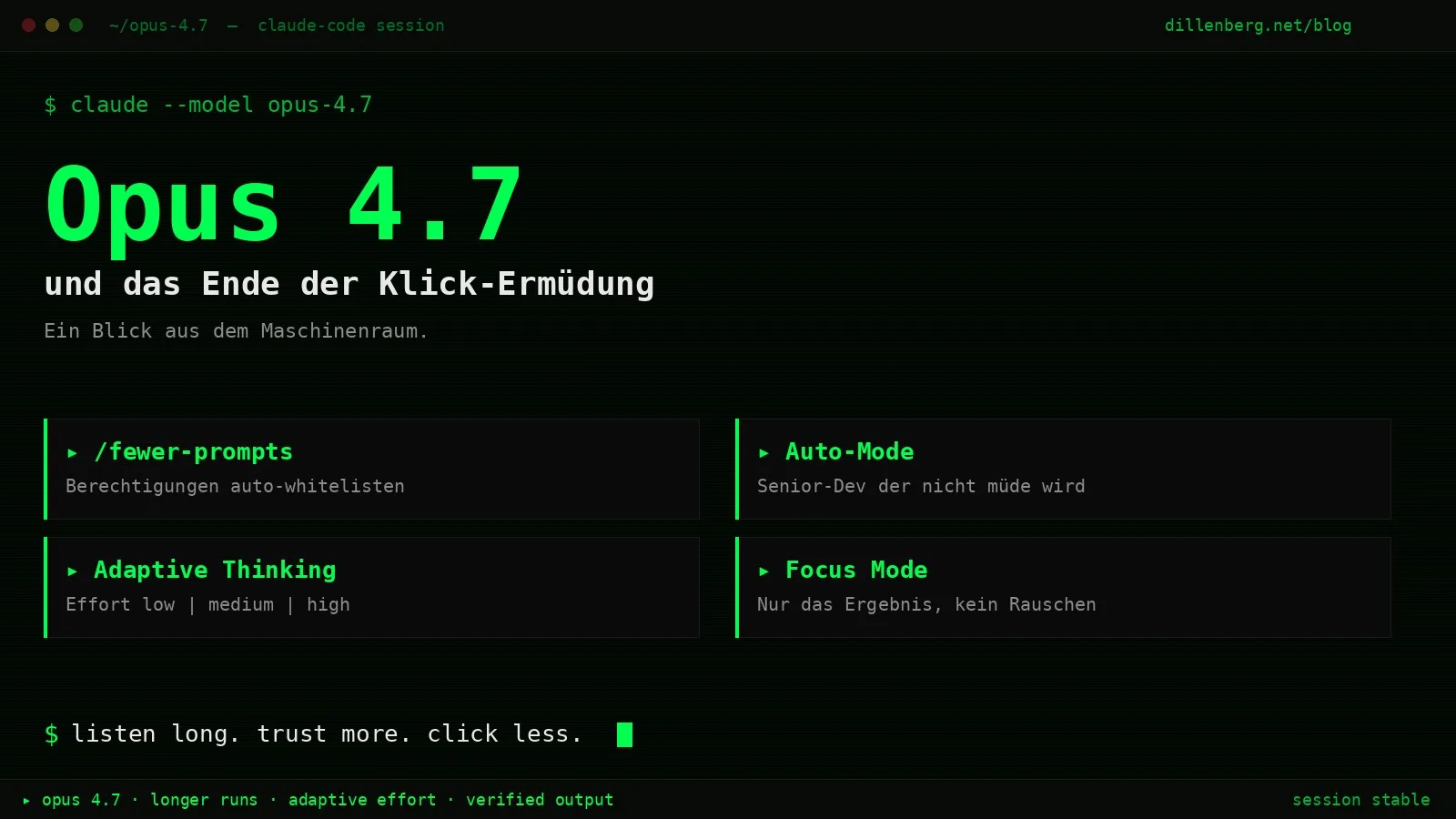
Opus 4.7 is here. And for the first time in a long while, I notice a model update not because I’m reading release notes — but because my workflow suddenly chafes less.
Fewer clicks, more flow
The new /fewer-permission-prompts scans the session history, finds the Bash and MCP commands I’m forever approving anyway, and builds a whitelist. Sounds trivial. It isn’t.
Over a year of Claude Code, I’ve clicked “Allow” what feels like ten thousand times. For ls, for git status, for grep. Every click was a micro-interruption. Now they’re gone.
The senior who never tires
“Auto mode is a gamechanger for long refactoring sessions.”
Someone wrote that on X, and the line stuck with me. Because it’s true.
Two years ago I’d have sliced big refactors into bite-sized pieces so the model wouldn’t lose the context. Today I just let Opus 4.7 run. An hour. Two. It keeps going while I do something else. Comes back with a green result.
It’s like a senior developer who never tires. Not annoyed when you have to explain what you want five times. Not sour when a test fails.
Adaptive thinking instead of quotas
Before: fixed thinking budgets, set by hand. Now: effort levels. Low for quick answers, high for hard problems. The model decides for itself how long to think.
That’s more than a performance tweak. It’s a vote of confidence — in me as a user, that I can judge whether a task is a one-second thing or a three-minute thing. And in the model, that it’ll actually use that judgment.
Focus mode — or: tuning out the noise
The new CLI optionally shows nothing but the final result. No intermediate steps, no tool calls, no noise.
Sounds like a feature for the impatient. But it’s really a philosophical switch: do I trust the agent, or do I look over its shoulder?
I trust it. The age of the shoulder-surfer is over.
Give the model a mirror
The tip I found most important: give Claude a way to check its own work. Tests, linters, typechecks, visible outputs. Whatever it takes.
“This has always been a way to make the result 2 to 3 times better. With 4.7 it matters more than ever.”
I’ve been building multi-agent systems for months. There, that mirror is what stands between “it works” and “it works consistently.” A critic agent, a test runner, a review pass. Without it, an agent is a monologue. With it, it becomes a dialogue.
What actually changed
Opus 4.7 isn’t “20% faster” or “15% more accurate.” Numbers like that say little.
What changed: I let the agent run longer. I click less. I watch less. I trust more.
That sounds like romance. But it’s just the sober observation that a tool is good precisely when you stop having to be the tool.
#ClaudeCode #Opus47 #AI #Workflow #Freelancer
Leave a Reply